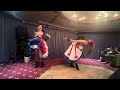
Not exactly the cancan, but counted amongst our all-time favorites nonetheless. Once again, we've used deep AI to give these exceptional pieces a new lease of life:


Not exactly the cancan, but counted amongst our all-time favorites nonetheless. Once again, we've used deep AI to give these exceptional pieces a new lease of life:
Tried to "clean up" some of the images I came across on BB's tumblr site; once again, I'll leave you to judge the results:


Bud and Lou bungle their way through yet another Universal Horror, this time as a pair of Brooklyn flatfoots sequestered to foggy London at the turn of the century. The movie includes two cancan scenes (kind of), the first during a suffragette rally in Hyde Park (get it?) and the second at the local watering hole. The musical number is performed by leading lady Helen Westcott and six anonymous show girls (with only the talented Ms. Westcott actually showing her knickers).

OK, you caught us out here: we added a pair of thigh highs via Photoshop, but you've gotta admit; it looks much better this way, doesn't it?
So, are you ready for another trip to The Judas Hole? Yes, that's right, it's time to review our favorite moments from The Haunted Strangler (Amalgamated, 1958):
Loosely based around the Whitechapel murders of the 1880s (with a dash of Jekyll & Hyde thrown in), the movie contains two extended cancan sequences set in a Victorian music hall. Like Jimmy Sangster's Jack the Ripper (Tempean Films, 1959), the movie was shot in black & white and contains virtuoso performances by professional dancers. According to some sources, the cancan scenes were choreographed by Joan Murray, a former Windmill Theatre alumnus.

Seriously, I still can't understand why nobody's come up with a color version of this masterpiece. Judging from these screencaps alone, the cancan number would be nothing short of spectacular!

We've tested several online colorization programs, and DeepAI still seems to be the best we've come across so far. We'll allow you to judge the results for yourself with these stills from 1959's Jack the Ripper:


Pulp magazines (often referred to as "the pulps") were inexpensive magazines that were published from 1896 to the late 1950s. The term "pulp" derives from the cheap wood pulp paper on which the magazines were printed. In contrast, magazines printed on higher-quality paper were called "glossies" or "slicks." The typical pulp magazine had 128 pages; it was 7 inches (18 cm) wide by 10 inches (25 cm) high, and 0.5 inches (1.3 cm) thick, with ragged, untrimmed edges.

The pulps gave rise to the term pulp fiction in reference to run-of-the-mill, low-quality literature. Pulps were the successors to the penny dreadfuls, dime novels, and short-fiction magazines of the 19th century. Although many respected writers wrote for pulps, the magazines were best known for their lurid, exploitative, and sensational subject matter, especially those of the "spicy" variety.

While held in low regard at the time of of publication, "spicy pulp" cover paintings are now considered exceptional pieces of American pop culture and are keenly sought after by collectors and enthusiasts alike.
- freely adapted from the Wikipedia article.


Eight years before Marilyn Monroe's iconic scene in The Seven Year Itch, Katy Keene found herself fighting the gale for close on six pages. The strip's creator, Bill Woggon, frequently "spiced up" the action with pin up pages and mild innuendo here and there (well, practically every issue TBH).

"Fanservice" elements were less common in other titles, though they managed to sneak in under the radar from time to time. Billed as "America's Typical Teenaged Girl," Ginger Snapp was a female version of Archie Andrews, complete with bright red hair and oddball supporting cast - although the similarities seem to have ended there. Unlike her better-known counterpart, Ginger occasionally treated her readers to gratuitous lingerie shots, complete with lacy black underwear and thigh-length suspender stockings.

Last (and quite possibly least) we have Owen Fizgerald's Moronica. Published by AGC in the early 50s, Moronica (yes, that was apparently her real name) was portrayed as ditzy, naive and accident-prone, ie a stereotypical "Dumb Dora" played exclusively for laughs. Appearing mainly in the back pages of Dizzy Dames (a more subtle title cannot be conceived), the strip ran for less than a year before its cancellation in June 1953. Strangely enough, the idea of an airhead blonde losing her clothes at the drop of a hat didn't catch on too well at the time. Guess there's just no accounting for taste.


 By contrast, 1959's Attack of the Giant Leeches may best be described as a horror in its own right. Take my word for it, this has to be one of the biggest turkeys this side of Plan Nine from Outer Space, and that's being as generous as humanly possible. Even the brief panty-scene near the start couldn't save this humongous lemon.